No results found. Try "big five", "career", or "leadership".
Appearance
Theme
Text size
Page width
No results found. Try "big five", "career", or "leadership".
Theme
Text size
Page width
Read it. Try it. Get your result.
Explore trusted assessments for work, career, learning, and personal growth—explained by their purpose, method, limits, and next steps.
What would you like to understand—or improve?
Pick a phrase that sounds like you, or type your own above.
The expert directory
The researchers and practitioners whose frameworks power this library — browse the directory, or search for a name.
No experts match “{{ expertQuery }}”. Try “goleman”, “flow”, or “big five”.

Big Five · OCEAN
Paul Costa & Robert McCrae
Trait psychology's flagship: five continuous dimensions, no personality boxes — four decades of cross-cultural validation.
View profile

Hierarchy of Needs
Abraham Maslow
From safety to self-actualization: what you need from work shifts as lower needs get met — and drives what you value next.
View profile

Five Conflict Modes
Kenneth Thomas & Ralph Kilmann
Competing, collaborating, compromising, avoiding, accommodating — five ways to handle disagreement, and two instincts most of us overuse.
View profile

Five Dysfunctions of a Team
Patrick Lencioni
Trust, conflict, commitment, accountability, results — a pyramid that traces most team trouble back to its foundation.
View profile

Team Development Stages
Bruce Tuckman
Forming, storming, norming, performing — most teams stay stuck not because of people, but because of the stage they are in.
View profile

Six Leadership Styles
Daniel Goleman
Visionary, coach, affiliate, democratic, pacesetter, commander — no single style wins; the best leaders flex between six.
View profile

Group Dynamics
Kurt Lewin
The founder of group dynamics: behavior is a function of person and environment — and the leader's climate changes both.
View profile

Growth Mindset
Carol Dweck
Beliefs about ability change outcomes: people who see intelligence as growable learn more — and recover from failure faster.
View profile
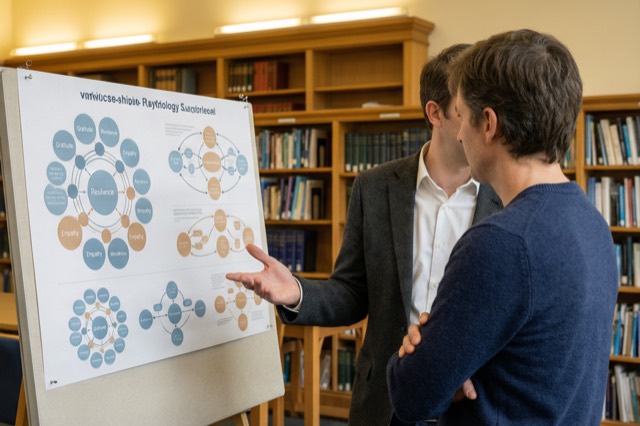
Character Strengths · VIA
Christopher Peterson & Martin Seligman
Twenty-four strengths under six virtues — positive psychology's answer to "what is right with you?"
View profile

Flow State
Mihaly Csikszentmihalyi
The psychology of full absorption: when challenge meets skill, attention stops drifting and work starts to feel effortless.
View profile

Deep Work
Cal Newport
Focused, undistracted work is rarer and more valuable as AI absorbs the shallow tasks. The question is whether your day still allows it.
View profile
Profiles are editorial — referenced, not affiliated. Scene photos are illustrative, not portraits.
Where to start
A workplace dilemma — what would you do?
{{ typedScenario }}▊
{{ dailyDilemma.question }}
Your choice: {{ dailyDilemma.choices[dilemmaChoice].text }}
Psychological Insight
{{ dailyDilemma.choices[dilemmaChoice].insight }}
Featured readings
Browse by situation
See the whole library at a glance — or jump straight to the situation that sounds most like yours.
Not sure which cluster fits? These entry points lead there.
Re-ground your direction with career values + strengths.
Career Direction →
Reflect on your conflict style before the next conversation.
Communication & Teams →
Find your default leadership style and how to flex.
Leadership →
Check your learning habits and growth mindset.
Learning & Growth →
Clarify your work values and focus mode.
Work Style →
Understand your work pace and feedback preferences.
Work Style →
Run by their authors
Assessments published and maintained by practicing coaches and trainers — separate from the editorial clusters above.
Theory Portals are author pages — not editorially reviewed by AssessWiki. Claims and content are the author's own. How this works
{{ fact.text }}
{{ fact.linkText }}Every entry follows the same structure: what it measures, who it is for, what evidence supports it, what it cannot tell you, and what to do next. Not marketing numbers — promises you can check on any page:
Every entry states its limits
A fixed “What it cannot tell you” section on all 51 entries — see it on the Big Five page →
Sources you can follow
Every entry’s “Evidence and sources” section links the published research behind it — see the evidence →
Free, with no sign-up
No account, no email gate, no paywall — start any assessment directly.
15 published frameworks, referenced
Entries are filed under the researchers behind the theory — referenced, not affiliated. Meet them →
AssessWiki stays free and editorially independent. Theory Portals are author-run pages, clearly labeled and never mixed into our editorial rankings. How we stay free
{{ comingSoon.title }}
This page is being prepared. Check back soon.